
How Much Does a Commercial Mural Cost in Virginia?
What I charge for commercial Mural in Virginia
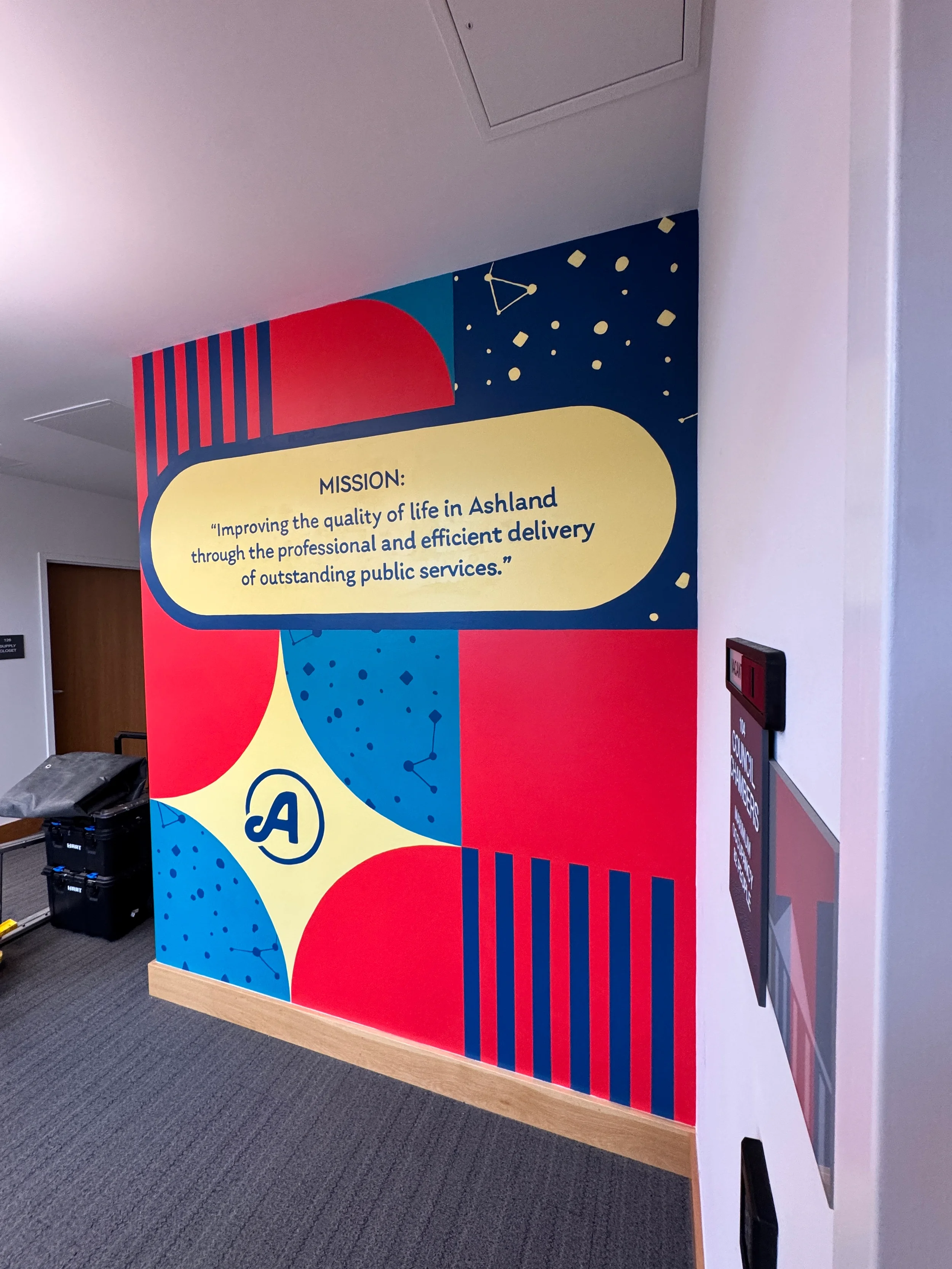
Ashland townhall office mural in Ashland, VA.
This should be the guide to help you with your next mural project. If you've been searching for a mural for your restaurant, boutique, office lobby, or storefront, you've probably noticed something frustrating: nobody posts real numbers. That's because mural pricing isn't one-size-fits-all. Every wall is different, and the investment reflects that.
As a working mural artist based in Richmond, I get this question constantly from business owners across Virginia. So let's break down exactly what drives the cost of a commercial mural, and what you can expect to budget.
My Pricing Method
I start every quote from a base rate per square foot, then adjust it up or down mostly based on three factors, plus one that often gets overlooked.
Factor 1: Size of the Wall
Square footage sets the baseline. The size of the wall anchors the estimate. But size alone never tells the full story, which is why it's a starting point rather than the whole formula. A 300-square-foot wall with a simple design can end up cheaper than a 100-square-foot wall packed with detail.
Factor 2: Surface Type
The surface changes how much prep and paint time a wall actually needs.
Smooth drywall - Paint goes on evenly with minimal prep
Brick, cinder block, or heavily textured stucco - the rate adjusts here. Uneven surfaces take more time to cover fully and use more paint to get solid coverage in the grooves and mortar lines (and if it has never been painted before, it needs a layer of heavy duty primer before the artwork goes on).
Corrugated metal - this gets its own special shout-out for being one of the most difficult surfaces and needing double the paint.
Factor 3: Level of Detail
I think of detail on a sliding scale, from bold and graphic to fully illustrative. A simpler design with a few flat colors moves quickly. Fine linework, shading, gradients, or photorealistic elements slow the pace considerably, since they require more layers and more precision. The more detailed the concept, the more that scale pushes the rate up.
Bonus Factor: Access
This is the one clients rarely think about upfront, but it directly affects labor time.
Ground-level, walk-up access — no adjustment needed. I can set up and work efficiently.
Ladder or scaffolding required — this adds setup, teardown, and slower working time, which I factor into the quote.
Lift required for tall or hard-to-reach walls — this adds both equipment rental cost and scheduling around lift availability.
Getting an Accurate Quote
When you reach out about a commercial mural, come prepared with:
Photos of the wall (a few angles, plus a wide shot showing surrounding context)
Approximate dimensions
Your general idea or inspiration for the design
Whether the wall is smooth, brick, block, or metal
How the wall is accessed (ground level, requires a ladder, requires a lift)
That gives me everything I need to put together a real, accurate estimate instead of a rough guess.
Ready to Talk About Your Wall?
I work with businesses across Richmond and Virginia on custom murals that fit their brand and their budget. If you have a wall in mind, reach out with a few photos and let's talk through what's possible.